Choosing a Washington State Park: Campsites, Hookups or a Cabin
Choosing a Washington State Park is easier when you start with the stay, not the park name. A tent site, an RV hookup and a cabin solve different problems, and each comes with trade-offs in comfort, equipment and planning. This guide helps you compare those options, read listings carefully and narrow your choices before you commit to dates.
Start with the kind of stay you want
Before comparing parks, decide what you need your overnight stay to do. Are you bringing a tent, driving an RV, or looking for a roof and a bed? Do you want to prepare most things yourself, or would you rather arrive with fewer pieces of camping gear? A clear answer to those questions can make a long list of parks manageable.
The Washington State Parks and Recreation Commission says most Washington state parks offer overnight camping accommodations, from basic campsites to full hook-up sites. The range is useful, but it does not mean every park offers every kind of stay. The specific park and site listing are what matter for your trip.
Think about the basics first:
- What are you sleeping in? A tent, a vehicle, an RV, or a roofed rental each has different space and setup needs.
- What do you need at the site? You may want utility hookups, a particular type of sleeping arrangement, or a location that works for your equipment.
- What are you willing to bring? A campsite may require you to pack most of your own shelter and sleeping gear. A roofed stay can reduce some of that load, but you should check exactly what the rental includes.
- How much uncertainty can you handle? A site that fits your vehicle and has the facilities you need can be worth more than a more scenic option that leaves important questions unanswered.
- When do you want to go? A park’s available camping areas and facilities can vary by season. Check the dates and current notices rather than assuming a listing applies year-round.
If you are choosing among several stay types, start with the one that rules out the fewest workable options. For example, if your RV needs a particular utility connection, check that requirement before comparing beaches, trails or other attractions. If you are bringing a tent and want a simple setup, you may have more flexibility to consider sites that do not offer hookups.
It also helps to separate “must have” from “would be nice.” A must-have could be a site that can accommodate your camping setup or a roofed unit suitable for your group. A preference might be a particular view, a quieter area or proximity to an activity. Make sure the must-haves are confirmed in the official listing; treat preferences as reasons to choose between options that already work.
This distinction prevents a common planning mistake: selecting a park because its setting sounds ideal, then discovering that the available accommodation does not suit your gear or expectations. Start with a feasible stay, then choose the park and location that make the trip appealing.
Compare campsites, hookups and roofed rentals
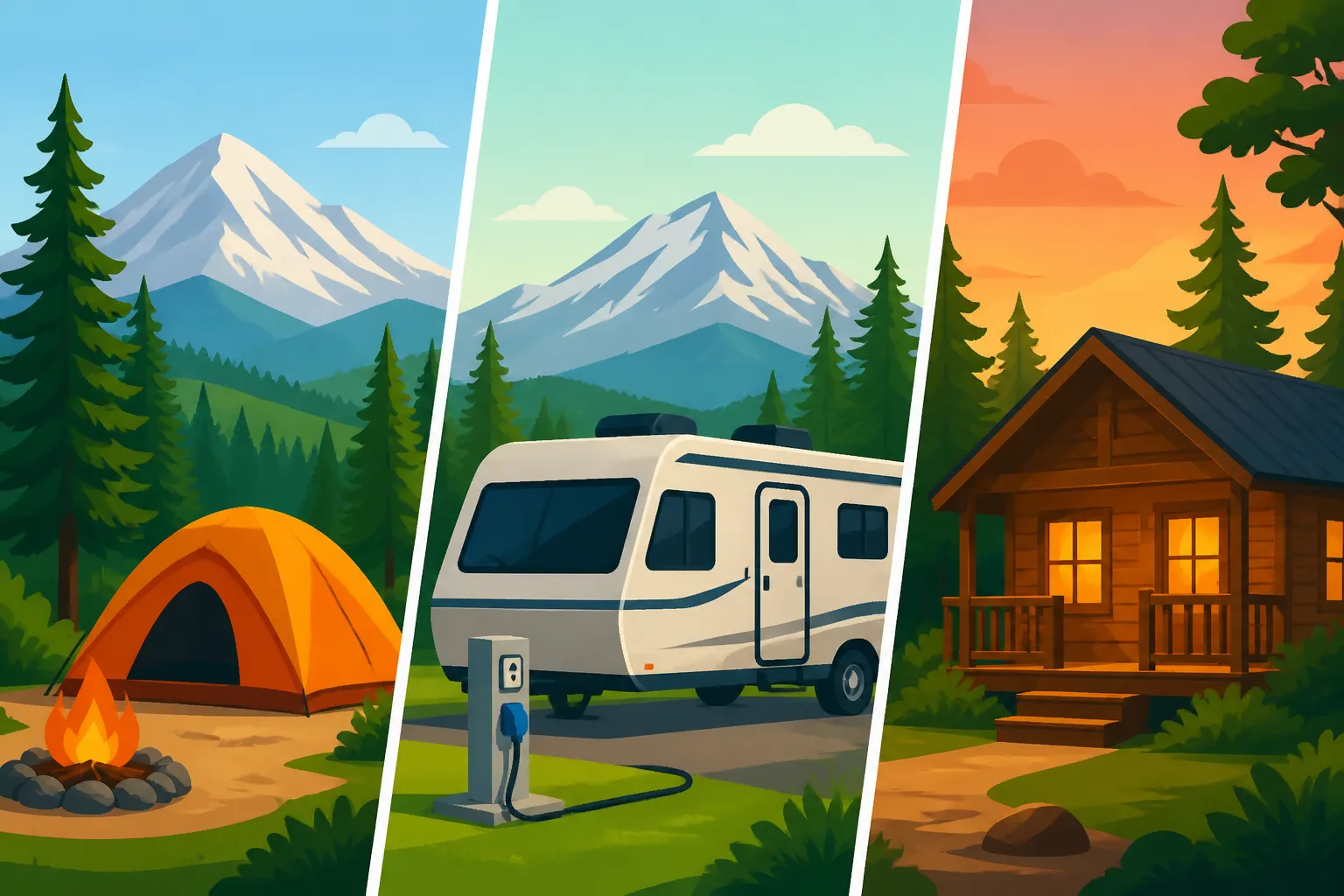
Each accommodation type offers a different balance of flexibility, comfort and preparation. The best choice depends on what you bring, how much setup you want and which features are essential. Use the comparison below as a first pass, then confirm the details for the exact park and unit.
| Stay type | Often suits | What to check before choosing |
|---|---|---|
| Basic campsite | Campers bringing their own shelter and sleeping setup | Site dimensions or capacity information, surface and layout details, and what facilities are nearby |
| Campsite with hookups | RV campers who need utility connections at the site | Which hookups are provided, connection details, site fit and whether the utilities are available for your dates |
| Cabin, yurt or other roofed stay | Visitors who want a roofed place to sleep or prefer not to bring a tent | Sleeping arrangements, included furnishings, cooking arrangements, access and the rental’s specific rules |
| Group or day-use shelter | A gathering that needs a shared covered space | Whether overnight lodging is allowed, group capacity information and whether the facility is rentable for your purpose |
The labels in a listing are a starting point, not a complete description. “Campsite” does not tell you whether it has utilities, how much room is available or what the immediate surroundings are like. “Cabin” does not tell you what sleeping gear, cookware or other supplies to bring. Compare the actual listing details rather than relying on the category name alone.
A standard, primitive or hookup campsite may be the right choice for different reasons. A simpler site can be a good match if you are prepared to camp without utility connections. A hookup site can better suit a vehicle that depends on a specified connection. To understand what different site labels mean, see Hookup, Standard or Primitive Campsites at Coastal Parks Compared and Electric, Water and Sewer Hookups at Washington State Parks Explained. Although one comparison focuses on coastal parks, use the park’s own listing to verify the setup at any specific location.
Roofed stays also cover more than one style. The Washington State Parks and Recreation Commission says cabins, yurts, vacation houses, day-use shelters and other rustic shelters are available for rent in many parks. That variety can help you consider a roofed option without assuming all rentals are alike. A day-use shelter, for example, should not be mistaken for overnight lodging; check the facility’s purpose and terms.
For a cabin or yurt, find out what the unit actually provides before deciding that it will simplify your packing. A roof over your head does not automatically mean that bedding, cooking equipment or other supplies are included. Check the individual unit’s amenity description, sleeping arrangement and access information. What’s Inside a Washington State Park Cabin or Yurt? can help you frame those questions.
The comparison also depends on the people in your party. A site that is comfortable for a couple may be a poor fit for a larger group, even if the reservation appears available. For a roofed rental, check the stated occupancy and sleeping arrangement rather than assuming that every person will have a separate bed. For campsites, confirm the listing’s capacity and setup limits, and do not plan to squeeze in extra people or equipment without checking the rules.
When cost matters, compare the total trip plan rather than looking at the accommodation label in isolation. The reservation may be only one part of what you need to budget for. Bring your own gear, fuel, food and other trip costs into the decision, and confirm current charges with the official reservation information. Do not assume a cabin automatically costs less than a campsite for your particular group, or that a site with more amenities is the better value if you will not use them.
Decide whether your campsite needs hookups
For RV travelers, the most important distinction may be whether the site’s hookups match the vehicle’s needs. A listing that mentions hookups does not by itself answer every practical question. Confirm whether the site offers the specific utilities you rely on, and check any stated limits or connection details for that site.
A useful way to think about hookups is to separate them into individual needs. Do you require electricity? Do you need a water connection at the site? Is sewer access essential during your stay, or can your setup manage without it? These are different requirements. A site with one utility connection may not provide the others, so do not treat “hookups” as shorthand for a complete set.
If you are flexible, make a short list of acceptable configurations before searching. For instance, decide whether a partial hookup is workable, whether you need a full hookup, or whether a campsite without utility connections is still an option. This gives you a clear filter and keeps you from reserving a site that looks suitable in a broad search but misses an essential connection.
Also check the physical fit. The site has to work for the RV itself and for the way you plan to park it. Look at the listed site information and compare it with your vehicle and equipment, including any vehicle you tow. A connection that suits the RV is not enough if the entire setup will not fit. If dimensions are unclear, confirm them with the park or official reservation system before completing your plans.
Do not assume that every loop or campsite in a park has the same utilities. Larger parks may have different site types in different areas, and a listing for one site should not be used to infer the features of another. Check the exact site or loop you plan to reserve. If an amenity is important, make sure it appears in the site-specific information rather than only in a general park description.
Water and utility availability may also change with operating conditions or season. A site listing can describe the normal setup while a current alert identifies a temporary closure or service interruption. Check the park’s alerts and the specific reservation information close to your departure. For a broader look at utility differences, see Electric, Water and Sewer Hookups at Washington State Parks Explained and Electric but No Sewer: What a Partial-Hookup Park Site Includes.
Tent campers should also read hookup descriptions carefully. A campsite with utilities can still be a campsite, but the availability of connections may not be useful to someone who does not need them. Instead, compare the site’s actual layout, location and facilities. A simpler site may fit a tent trip better, while an RV traveler may need to prioritize connection type and vehicle fit.
For both tent and RV campers, write down the questions that would change your decision. Examples include:
- Does this exact site offer the utility connection I need?
- Is the listed site suitable for my camping setup?
- Are water or other services seasonal or subject to temporary interruption?
- Does the site information account for my full vehicle setup?
- Is there a current alert that affects the loop or facility?
If the official listing does not answer a critical question, do not fill the gap with assumptions. Check the park’s information or use the official reservation system for clarification. A few minutes spent confirming the fit can prevent a stressful arrival.
Choose a roofed stay without guessing what it includes
A cabin or yurt can be appealing if you want to camp without bringing a tent, or if your party prefers a roofed place to sleep. It can also make sense when you are traveling with equipment that is difficult to carry or when the group would rather share a furnished space. But “roofed” is not a full inventory. Each unit can have its own features, access conditions and preparation needs.
Start by checking the unit’s name and type. A cabin, yurt, vacation house or rustic shelter may have a different layout and purpose. Confirm that the space is intended for overnight use and that it is available for the dates you want. If you are considering a day-use shelter, confirm its use rather than assuming it provides overnight accommodation.
Next, check the sleeping arrangement. Look for how the listed beds or sleeping surfaces are arranged and whether the setup suits your party. Consider who is comfortable sharing a space, who may need easier access and how much personal gear everyone will bring. A unit’s stated capacity and its sleeping arrangement answer related but different questions: capacity indicates who may be accommodated under the listing, while the sleeping layout helps you decide whether the space will be comfortable for your group.
Then make a packing list from the actual amenity details. Check whether the description mentions bedding, cooking facilities, utensils, heat, lighting or other features you are counting on. If something is not listed, do not assume it is supplied. Read What’s Inside a Washington State Park Cabin or Yurt? and Packing for a Park Cabin Weekend: Linens, Cookware and Firewood as planning references, then confirm the details for the particular rental.
Access matters as much as the interior. Check where the unit is located in relation to parking, the route to the entrance and any terrain or steps mentioned in the listing. If anyone in your party has mobility needs, look for relevant accessibility details rather than relying on a general label like “cabin.” Accessible Campsites and Cabins at Washington State Parks offers a useful starting point for this part of the comparison.
Pets require the same careful, unit-specific approach. Do not infer that a pet is allowed because another cabin in the park permits one, or because the park allows pets in some areas. Check the particular rental’s policy and any associated conditions before booking. If a pet is part of the plan, verify the policy while comparing units, not after you have chosen one.
Also think about the difference between avoiding camping equipment and avoiding preparation altogether. A roofed stay may reduce the need to bring shelter, but you may still need to bring personal items, food, cooking supplies or bedding depending on the unit. It may also require planning for check-in, access and cleanup. The official unit description should guide that preparation.
The right roofed stay is not necessarily the one with the longest amenity list. Choose based on the needs that matter to your group. If your priority is a straightforward place to sleep, some features may not add value. If your group needs a particular cooking arrangement or an accessible route, those details may determine whether a unit is workable at all. Keep the decision grounded in confirmed features rather than the name or photographs alone.
Match the park setting to the trip
Once you have identified a workable type of stay, compare the settings. A state park may be attractive because of its landscape or activities, but the best choice depends on what you want to do and how much time you have. Consider the overall trip rather than treating the campsite as the whole experience.
Ask yourself what you want to spend time doing. A trip focused on outdoor recreation may call for a location near the activities your group has in mind. A restful weekend may benefit from a site or rental that feels comfortable for time spent at camp. A road trip might favor a stay that fits your route and leaves enough time to set up and explore. These preferences are personal; the useful step is to identify them before choosing a park.
Next, compare the practical location of the accommodation within the park. Parks can have more than one campground, loop or lodging area, and those locations may differ in setting and access. Read the map and listing for the specific area you are considering. Do not assume that a park’s name or general description tells you where a particular campsite or cabin is situated.
Look at details that can affect comfort even when they are not headline amenities:
- How far is the site from the facilities you expect to use?
- Is the site in an area that suits your preferred level of activity or quiet?
- Does the route from parking to the unit match your equipment and mobility needs?
- Is your chosen loop open for the dates you are planning?
- Does the accommodation sit near the part of the park you most want to visit?
A scenic location does not automatically make a site more comfortable. A slope, exposure, nearby activity or distance from a facility can matter more to your group than a view. Read the listing and available map carefully, and use Sizing Up a Single Campsite for Shade, Slope and Restroom Distance if you are comparing individual sites.
Think about the season as part of the setting. Some camping areas or facilities may operate differently at different times. A park that looks like a good fit in one season might have a different selection of open loops or amenities during another. Check the calendar for your exact dates and review current park notices before finalizing the plan. For more on seasonality, see Year-Round or Summer Only? Camping Seasons at Washington State Parks and Peak, Shoulder or Winter? Working Out Your Park Dates’ Season.
If the park is near water or a popular recreation area, verify the features you intend to use rather than assuming they are available, open or suitable for everyone in your party. General park information can help you choose a destination, but current alerts and specific facility pages are more useful for day-of decisions. Checking Washington State Park Alerts and Closures Before You Go explains why checking notices belongs in the plan.
It can be helpful to compare parks using a small shortlist rather than trying to rank every possible option. For each candidate, note the accommodation that fits, the setting you want, the practical details you still need to confirm and any reason to rule it out. A simple comparison can look like this:
| Park option | Stay type that fits | Setting or activity appeal | Questions to confirm |
|---|---|---|---|
| First choice | The campsite or rental that meets your must-haves | The feature that makes this park appealing | Site fit, amenities, seasonal availability or current alerts |
| Backup choice | A workable alternative stay type | A different setting that still suits the trip | Whether dates and facilities are available |
| Flexible option | A stay that works if plans change | A convenient or lower-priority preference | Any remaining details that could affect arrival |
This approach keeps the decision practical. It also gives you a backup if the preferred accommodation is unavailable for your dates. A backup should be a genuine alternative, not merely a park name: check that it offers a stay type your party can use and that its location still works for the trip.
Read the listing and confirm the details
A good park choice can still go wrong if you misunderstand the listing. Before booking, read the park page and the individual accommodation description together. The park page gives context about the location and facilities, while the campsite or rental listing should answer questions about the specific unit.
For a campsite, review the site type, any listed capacity or dimensions, utility connections, access and location. If you are bringing an RV, compare the listing with your vehicle setup. If you are tent camping, look for the information that affects your shelter and gear. If you are choosing a site from a map, make sure the map corresponds to the same campground area and reservation listing.
For a roofed rental, review its unit type, sleeping arrangement, amenities, access and policy details. Treat photographs as helpful context, not a substitute for written information. A photo may show a room but not tell you what supplies are included or whether the sleeping arrangements meet your group’s needs.
A consistent review process helps:
- Confirm the park and accommodation type. Make sure you are looking at the intended park, campground, loop or rental.
- Check the exact dates. Availability and seasonal operations can vary, so verify the dates rather than assuming a facility is open.
- Read the site or unit description. Look for the features that determine whether the stay is workable.
- Compare capacity and fit. Confirm that your group and equipment are allowed and physically suited to the space.
- Review current notices. Check alerts or closures that could affect access, services or your plans.
- Resolve unanswered questions before committing. Use the official park information or reservation system to confirm details that matter.
The reservation calendar and listing are useful, but they are not always a substitute for current operational information. If a utility, loop or access route is central to your choice, check whether an alert changes what the general description suggests. State park operations can change, so check notices before departure and again as you prepare to arrive.
Keep a record of what you confirmed. A short note with the site name, utility setup, arrival information and any open questions can help prevent confusion when you return to the booking page. If you are comparing several options, use the same checklist for each one so that you are not comparing a fully researched site against a vaguely remembered alternative.
Do not rely on a third-party summary for a detail that could affect whether you can stay. Use the official listing for the exact accommodation, and verify current requirements or availability through the official reservation system. For help interpreting the booking page, see Reading a Campsite Listing on the State Parks Booking Site and Step by Step: Picking Dates, a Loop and a Site on the Booking Page.
Turn your shortlist into a workable booking plan
Once you have chosen a stay type and found a park that appears suitable, check availability for the dates you want. Your preferred choice may not be open, so identify alternatives before you reach the point of booking. A second-choice site, a different loop or another kind of accommodation can keep the trip moving without forcing a poor fit.
Be prepared to adjust one part of the plan at a time. If a preferred hookup site is unavailable, decide whether a site with a different utility setup would work. If a cabin is booked, consider whether your group can use a campsite or another roofed unit. If the dates are the problem, ask whether a different trip window would still suit the purpose of your visit. Making those decisions in advance is easier than trying to improvise after a preferred option disappears.
The reservation process should follow your accommodation choice, not drive it. Before you book, double-check that you are reserving the stay you evaluated: the right park, the intended dates, the correct campsite or rental, and the features you relied on. A similar name or nearby loop does not guarantee the same utilities or layout.
If you are choosing between an RV site and a cabin, compare what each option means for the whole party. An RV site may suit the person bringing the vehicle and gear, while a roofed rental may be more practical for someone who does not want to sleep in the RV or tent. A mixed plan can work only if each reservation and its rules are clear. Confirm the terms for every accommodation rather than assuming arrangements in one area apply to another.
Be realistic about arrival and setup. A site that looks ideal on the map may involve a route or layout that is inconvenient for your vehicle or gear. A cabin that solves the shelter question may still require you to carry supplies from parking. If the listing does not make these details clear, get clarification before finalizing the plan.
After booking, revisit the official information as your trip approaches. Check for park alerts, closures, service changes or updates that affect your reserved accommodation. Then check again before leaving and when you arrive. Do not assume that a booking guarantees every nearby facility or feature will be operating as planned.
For a more detailed sequence, see How to Reserve a Washington State Parks Campsite, Cabin or Yurt. If a site is unavailable, Reserving Early for Washington’s Most Popular State Parks and Spotting Campsite Cancellations Without an Alert Service may help you think through alternatives. The useful goal is not simply to secure any available place; it is to find a stay that still works for your equipment, group and trip.
Frequently Asked Questions
Is a cabin always easier than a campsite?
Not necessarily. A cabin can reduce the need to bring a tent, but the unit may still require you to bring supplies or plan around its layout and access. Check the exact amenity description and sleeping arrangement before deciding.
Does a campsite with hookups include every utility?
No general label is enough to confirm that. Check the individual site listing for the specific connections provided and whether they meet your needs.
Can I assume every state park offers cabins or yurts?
No. Roofed accommodations are available in many parks, but not every park offers every type. Search for the specific rental and confirm that it is available for your dates.
What should I verify before choosing an RV site?
Confirm the utility connections, site information and fit for your RV and any equipment you are bringing. Check current park notices as well, especially if your plans depend on a particular service or campground area.
What if the listing leaves out a detail I need?
Do not guess. Check the official park information or reservation system and confirm the detail before you commit to the stay.
Sources
- Washington State Parks and Recreation Commission — Camping | Washington State Parks (checked November 22, 2026)
- Washington State Parks and Recreation Commission — Rent a place | Washington State Parks (checked November 22, 2026)
Disclaimer
This article is for general informational purposes only and does not constitute professional advice. Laws, prices and regulations vary by location and change over time. Consult a qualified professional for guidance on your specific situation. Washington Camping & RV is not a government agency and is not affiliated with any government agency.